


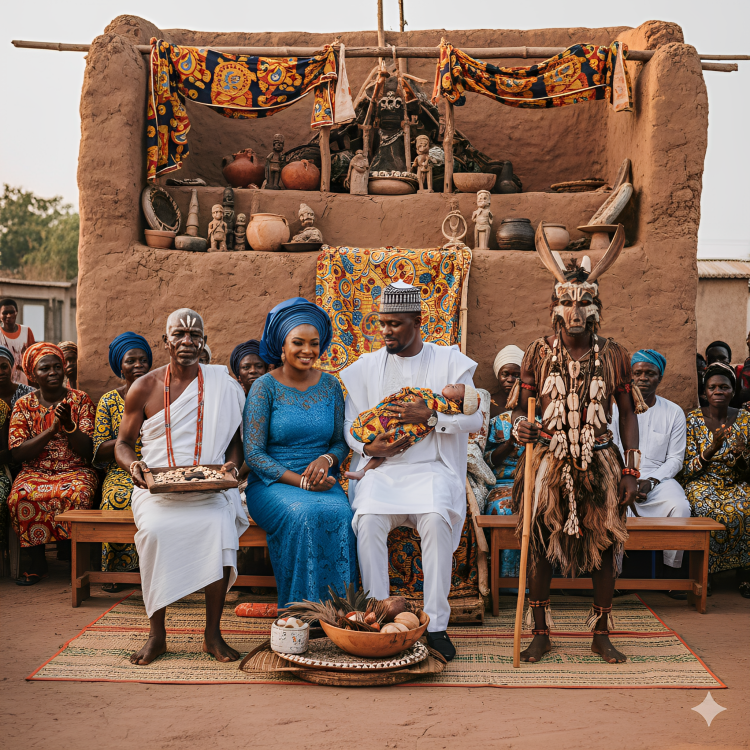
The Ebira people, renowned for their strong communal bonds of families, kindreds, clans, and sub-clans, hold a profound belief: every child born into their community is seen as the return of a long-departed family member. The arrival of a new baby is always a cause for immense joy, regardless of gender.
Shortly after birth, typically on the ninth day, a naming ceremony takes place. During this ritual, the child is presented to an elder who gently breathes into the baby’s right ear, whispering, “isa Adawú oka’awú, wawú” – an instruction to “Obey and work with whatever your father tells you.” The elder repeats this on the left ear, emphasizing obedience to both parents.
Eva Ozi and Oyi Ye Ozi: Child Divination in Ebiraland
While the initial naming sets a foundation, further traditional practices delve deeper into a child’s spiritual journey.
Eva Ozi: Divining a Child’s Path
Between seven and nine months of age, or sometimes during the toddler years, parents may seek Eva Ozi (child divination) to understand their child’s destiny. This practice is often prompted if a child exhibits unusual or precocious behaviors reminiscent of a deceased relative, leading parents to suspect an ancestor’s reincarnation.
Eva Ozi is performed by an Oheva, a fortune teller who uses cowries to commune with deities, seeking revelations about the child’s future. The Ebira people deeply value this tradition, believing it can unveil a child’s destiny. If a good fate is foreseen, offerings and praises are given to the gods. Conversely, if a challenging destiny is revealed, sacrifices are made to appease the deities and seek a positive change.
During Eva Ozi, certain “IDO” (customary duties) may be prescribed for the child to observe throughout their life. For instance, some children might be forbidden from eating snails, while young girls might be prohibited from carrying clay pots on their heads. In the past, Eva Ozi ceremonies were grand affairs, celebrated with great fanfare.
Broadly, Eva Ozi serves two main purposes:
- To discover a child’s overall destiny or “moira.”
- To identify the specific ancestor reincarnated in the child (Oyi Ye Ozi).
Oyi Ye Ozi: The Rites of Reincarnation
As mentioned, the Ebira believe every child is a returning ancestor. Oyi Ye Ozi is the specific ritual designed to determine which ancestor has reincarnated within the child’s lineage and to understand the reason for their return. It also serves as a process to appease the returning ancestor, seeking their guidance, protection, and positive influence on the newborn. Oyi Ye Ozi is typically integrated into the broader Eva Ozi ritual.
See our full article regarding Reincarnation (Onovave)
On the day of the Eva Ozi, representatives from both the child’s maternal and paternal families are present as witnesses. Their presence is crucial for identifying which side of the family the ancestor has returned from, as every returning ancestor must have an ancestral connection to the child, no matter how distant.
During the divination, the Oheva mentions names of long-deceased ancestors to pinpoint who among them has returned. Occasionally, a returning ancestor may choose not to reveal themselves on that particular day, prompting the selection of another date for them to “show their face” (Deyi Tu Ehe).
Once the ancestor is revealed, further inquiries are made into their reasons for returning. This is done to help guide the child as they grow, encouraging them to uphold the ancestor’s positive legacies or, less commonly, to appease the ancestor to alter a negative past mission.
Common reasons for ancestors to reincarnate include:
- They were deeply loved in their previous life and returned to reciprocate that affection.
- They did not live out their desired number of years and have returned to complete their lifespan.
- They had significant achievements left undone in their lifetime and have come back to accomplish them.
The returning ancestor is also asked to name what can be offered to honor their return. This could range from:
- Sacrificing a cow.
- Rearing a sheep.
- A special meal of pounded yam with egusi soup, garnished with dried catfish.
- The beating of the family’s ancestral hollow drum (agidigbo).
Finally, the ancestor chooses a living relative present at the ceremony to carry the child home on their back. This chosen relative automatically becomes the child’s godparent. They are dressed in white, their face marked with “Uru” (camwood), and the child is also dressed in white and covered with a white cloth while being carried. This procession is often accompanied by praise-songs eulogizing the returned ancestor.
The Enduring Significance of Child Divination in Ebiraland
The Ebira people firmly believe that every child is a reincarnation of a progenitor. To guide that child through life and, at times, to avert misfortune, undergoing these reincarnation rites is considered essential for identifying the specific ancestor who has returned.
While the advent of Islam and Christianity has influenced Ebira society, seeking to curtail such practices, it’s important to note that many still observe these ancient rites. Furthermore, it’s believed that individuals whose parents neglected these ceremonies often face turbulent lives, marked by misfortune, sickness, and stagnation. In such cases, elders frequently advise them to seek out and appease the ancestor reincarnated within them. When these rituals are performed, it is often believed that calamities are averted, and the individual finds freedom from their ordeals.
The rite of reincarnation is a truly beautiful and intricate part of Ebira culture that deserves exploration. It highlights the unique identity of the Ebira people and the profound interconnections within their community.
Written By: Salami Amina Ann
We encourage you to drop your comments below and share this article with friends. Follow us on Facebook to stay connected!


0 Comments